


AI Pricing Strategy: How Teams Price AI Products in 2026

July 7, 2026 - 6 min read

Author
Pricing is supposed to help buyers decide. In AI-native software, it often makes them calculate.
The AI pricing market has a wild west quality right now. A pricing page can ask a buyer to compare seats, credits, agents, projects, messages, API calls, model usage, team limits, and a "contact sales" button in one sitting. For the team selling the product, that same page has to protect margin while the cost of every generated output, enrichment run, or agent workflow keeps moving.
Shipyard's new Pricing Research Report studies 253 top Product Hunt launches from H1 2026, with pricing-plan analysis across 103 products that publish pricing. The dataset captures how young AI-native products are making pricing decisions while usage patterns, model costs, and buyer expectations are still shifting.
A few numbers frame the problem:
- 89.3% of the 253 categorized products are AI-enabled.
- 35.6% of the categorized products are AI agents.
- 54.4% of products include custom pricing in some form.
- 14 different billing units appear across the analyzed products.
- 45.6% of the products with public pricing offer a free tier.
Those numbers point to a market that has moved faster than its pricing language.
Agents Set The Pricing Tone
AI has become the default position for new software in this sample. Shipyard found 226 AI-enabled products among 253 categorized launches. Agents form the largest category, with 90 products, or 35.6% of the sample.
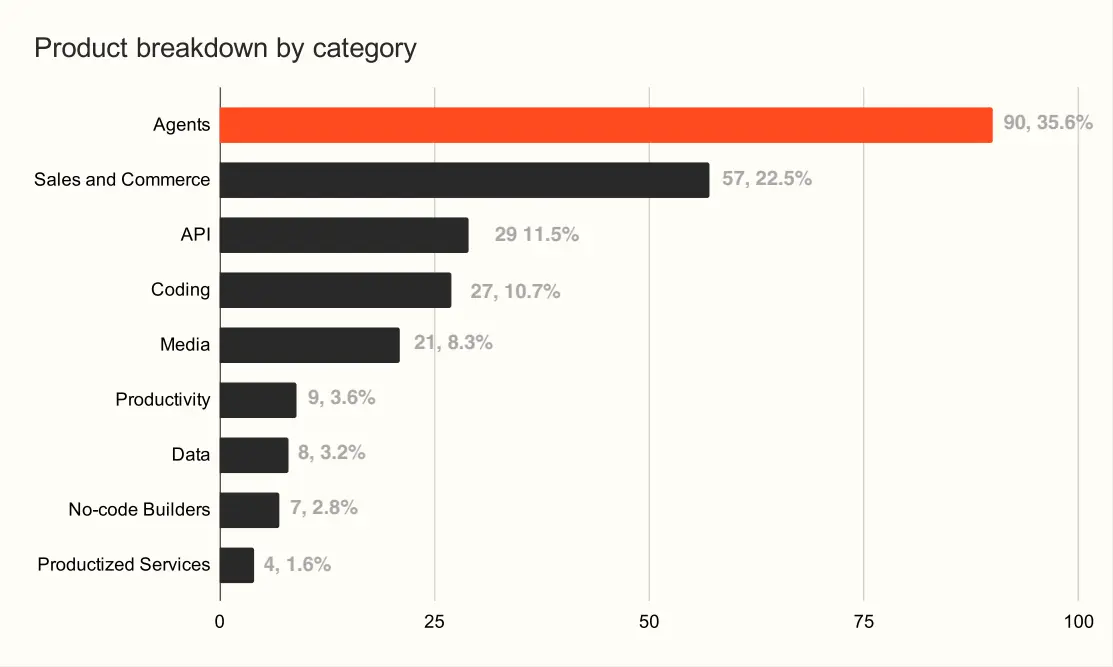 That matters because agent products turn pricing from access into activity. A buyer may see a monthly subscription, while the product team has to track the cost of runs, retries, model calls, integrations, storage, and support. A workflow that looks simple on the pricing page can carry several cost drivers underneath.
The old SaaS habit of charging mainly by seat starts to strain here. An AI agent can work for one user or ten users, run once a week or hundreds of times a day, and trigger different infrastructure costs each time. Pricing has to account for that spread before the product reaches heavy usage.
Agent Pricing Is Already Layered
Among the 103 products with publicly available pricing, 37 are AI agents. Inside that category, one product can use several pricing mechanics at once: subscriptions, usage limits, custom plans, token or credit systems, free tiers, and seat-based charges.
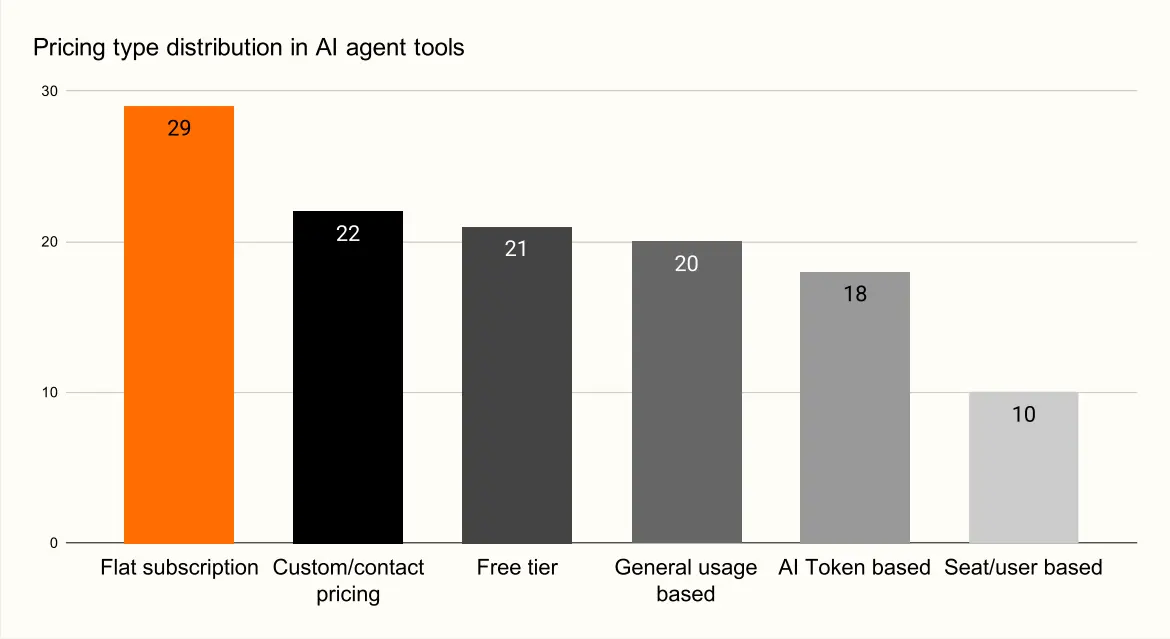 Flat subscriptions appear 29 times among AI agent tools, while custom/contact pricing appears 22 times and free tiers appear 21 times. These counts exceed the number of agent products because many products combine mechanics inside the same pricing page.
For founders, this creates a practical design problem. A pricing model has to explain value, protect margin, and stay legible. If the plan includes too many limits, the buyer has to decode the product before trying it. If the plan hides usage too much, the founder may learn about margin pressure after the first group of power users arrives.
Free Access Needs Guardrails
Free access is common in the report sample. Of the 103 products with public pricing, 47 have a free tier, or 45.6%.
That figure can sound generous until you look at the structure. The report finds that free access is usually controlled through restricted features, usage credits, trials, beta access, or self-hosted options. That pattern makes sense for AI products. A free plan helps buyers experience the workflow, yet every free AI action can still trigger real cost for the builder.
For a team launching an AI product, the free tier should answer a concrete question: how much product value can a user experience before usage starts hurting margin? A founder pricing an agent tool, for example, may choose to give away a small number of runs rather than a vague "free forever" promise. The buyer gets a real trial. The vendor keeps the cost boundary visible.
The full report goes deeper into which categories lean toward free access and where teams are more cautious.
Custom Pricing Is Carrying Vendor Risk
Custom pricing shows up across more than half of the products analyzed. Only 29 of the 103 products rely on listed flat pricing alone. In the same sample, 68 products include custom/contact pricing in some form.
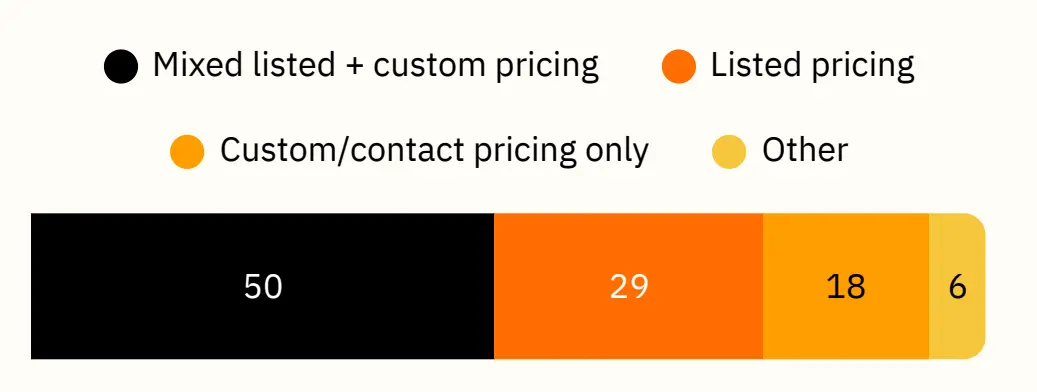 This is one of the clearest signals in the report. Vendors use custom pricing when a public table has too little room for the whole economic story. High-volume usage, larger teams, security reviews, support expectations, data handling, and uncertain AI compute costs all push toward a conversation.
Custom pricing can be a sensible way to handle vendor risk. Buyer risk appears when the trigger is unclear. A startup evaluating an AI tool may accept custom terms for enterprise usage, but the team still needs to understand when higher limits, production workloads, or advanced support will move them out of public pricing.
The gated report breaks down the conditions attached to custom pricing, including the triggers vendors mention most often. That section is useful for founders deciding what belongs in a public plan and what belongs behind a sales conversation.
The Meter Count Is Getting Heavy
Usage-based pricing is becoming hard to avoid in AI products. The report found 14 different billing units across subscription and custom plans. Credits appear most often, with 38 occurrences. Models or agents and projects appear 29 times each. Seats or users appear 28 times.
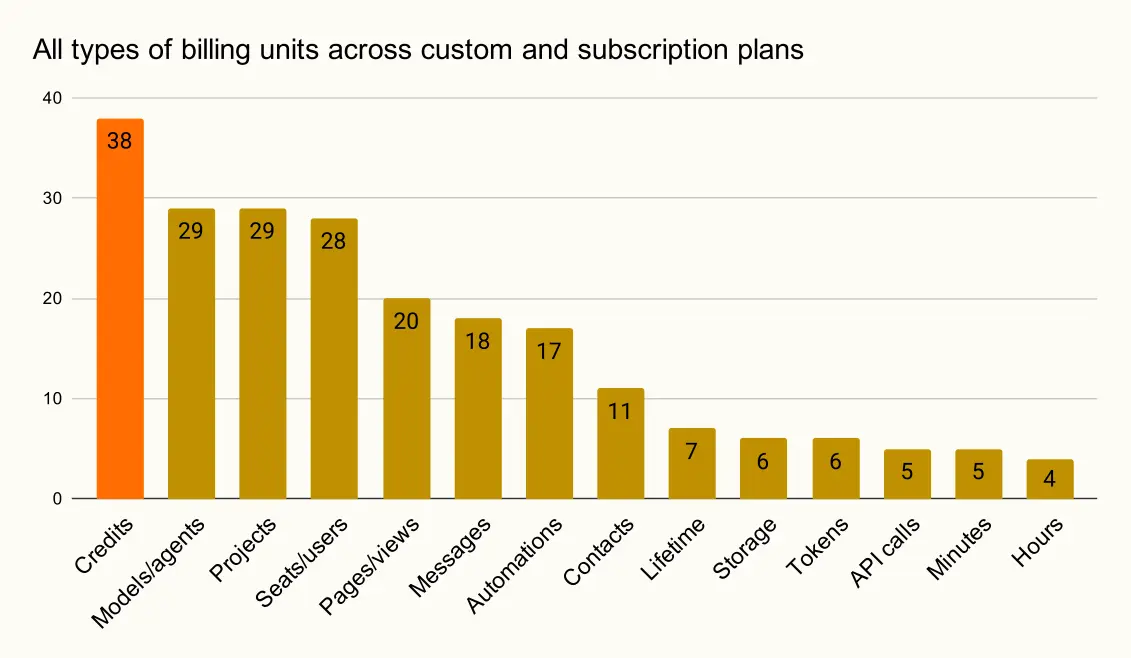 Credits are popular because they give vendors a shared unit for different kinds of work. They also shift translation work to the buyer. A buyer has to ask what one credit means, how many credits a normal workflow consumes, and what happens when a heavier use case arrives.
This is where AI pricing gets cognitively expensive. One plan can include credits, messages, workspaces, sending limits, model-specific actions, and domains. Before buying, the user has to understand each limit. After buying, the user has to watch those limits during actual work.
Good AI pricing should map usage limits to real product behavior. "500 credits" means less than "enough credits to run 50 prospecting workflows with enrichment and AI-drafted emails." The credit count lists an internal unit. The workflow example helps the buyer plan.
What Builders Should Take From The Report
The report's core finding is simple enough to say plainly: AI pricing is becoming multi-metered because AI products sell work performed by software. That work creates cost, and cost has to show up somewhere in the pricing model.
The harder questions sit underneath that finding. Which meter belongs in the public plan? Which usage patterns require a custom plan? How much free usage is enough to prove value? When does a subscription become a wrapper around credits, runs, messages, and model calls?
Shipyard's full Pricing Research Report answers those questions with category-level patterns, plan-level pricing observations, custom-pricing triggers, and practical takeaways for builders. It is written for solo founders and small teams who need to set pricing before the market teaches them through margin loss.
Download the full Shipyard Pricing Research Report to see the complete analysis behind these charts.

About the Author
Hussain Ali

With over 16 years of expertise, Hussain is a distinguished professional in full stack, mobile, game, and blockchain development. As a solution architect, he excels in pre-sales, displaying a strong inclination towards innovative strategies. Hussain has significantly impacted the gaming industry, contributing to both 2D and 3D games. Beyond coding, he actively shapes entire game narratives, including mechanics and story development. Dedicated to solving intricate challenges, he crafts meticulous technical proposals for Request for Proposals (RFPs), ensuring seamless integration of technology and business objectives.


Accelerate Your Projects With Our On-Demand Developers
Let's TalkTalent Shortage Holding You Back? Scale Fast With Us
Frequently Asked Questions
How do you handle different time zones?

With a team of 150+ expert developers situated across 5 Global Development Centers and 10+ countries, we seamlessly navigate diverse timezones. This gives us the flexibility to support clients efficiently, aligning with their unique schedules and preferred work styles. No matter the timezone, we ensure that our services meet the specific needs and expectations of the project, fostering a collaborative and responsive partnership.
What levels of support do you offer?
We provide comprehensive technical assistance for applications, providing Level 2 and Level 3 support. Within our services, we continuously oversee your applications 24/7, establishing alerts and triggers at vulnerable points to promptly resolve emerging issues. Our team of experts assumes responsibility for alarm management, overseas fundamental technical tasks such as server management, and takes an active role in application development to address security fixes within specified SLAs to ensure support for your operations. In addition, we provide flexible warranty periods on the completion of your project, ensuring ongoing support and satisfaction with our delivered solutions.
Who owns the IP of my application code/will I own the source code?
As our client, you retain full ownership of the source code, ensuring that you have the autonomy and control over your intellectual property throughout and beyond the development process.
How do you manage and accommodate change requests in software development?
We seamlessly handle and accommodate change requests in our software development process through our adoption of the Agile methodology. We use flexible approaches that best align with each unique project and the client's working style. With a commitment to adaptability, our dedicated team is structured to be highly flexible, ensuring that change requests are efficiently managed, integrated, and implemented without compromising the quality of deliverables.
What is the estimated timeline for creating a Minimum Viable Product (MVP)?
The timeline for creating a Minimum Viable Product (MVP) can vary significantly depending on the complexity of the product and the specific requirements of the project. In total, the timeline for creating an MVP can range from around 3 to 9 months, including such stages as Planning, Market Research, Design, Development, Testing, Feedback and Launch.
Do you provide Proof of Concepts (PoCs) during software development?
Yes, we offer Proof of Concepts (PoCs) as part of our software development services. With a proven track record of assisting over 70 companies, our team has successfully built PoCs that have secured initial funding of $10Mn+. Our team helps business owners and units validate their idea, rapidly building a solution you can show in hand. From visual to functional prototypes, we help explore new opportunities with confidence.
Are we able to vet the developers before we take them on-board?
When augmenting your team with our developers, you have the ability to meticulously vet candidates before onboarding. We ask clients to provide us with a required developer’s profile with needed skills and tech knowledge to guarantee our staff possess the expertise needed to contribute effectively to your software development projects. You have the flexibility to conduct interviews, and assess both developers’ soft skills and hard skills, ensuring a seamless alignment with your project requirements.
Is on-demand developer availability among your offerings in software development?
We provide you with on-demand engineers whether you need additional resources for ongoing projects or specific expertise, without the overhead or complication of traditional hiring processes within our staff augmentation service.
Do you collaborate with startups for software development projects?
Yes, our expert team collaborates closely with startups, helping them navigate the technical landscape, build scalable and market-ready software, and bring their vision to life.
Our startup software development services & solutions:
- MVP & Rapid POC's
- Investment & Incubation
- Mobile & Web App Development
- Team Augmentation
- Project Rescue
Subscribe to our blog
Related Posts
Get in Touch with us
Thank You!
Thank you for contacting us, we will get back to you as soon as possible.
Our Next Steps
- Our team reaches out to you within one business day
- We begin with an initial conversation to understand your needs
- Our analysts and developers evaluate the scope and propose a path forward
- We initiate the project, working towards successful software delivery