


AI Development Outsourcing: Models, Costs, and Vendor Selection

September 10, 2026 - 9 min read

Author
AI Development Outsourcing: Models, Costs, and Vendor Selection
Only one in five companies had mature rules for AI agents in Deloitte's 2026 study. It covered 3,235 senior business and IT leaders across 24 countries. When another company builds the system, this problem is magnified. The project moves fast while clear control is missing.
AI development outsourcing provides a company with scarce expertise and can significantly speed up the project. At the same time, it also raises hard questions about data use and leaves the quality and cost a mystery.
The best set-up is a partnership with split responsibilities. The outside team speeds up the build, while the buyer's team controls the product judgement and lifecycle ownership.
What AI development outsourcing can cover
AI development outsourcing means bringing in an outside team to build part or all of an AI system.
The project may start with early advisory work and discovery. Then, depending on the requirements, it can include a small PoC test, full-scale development, integrations with the client's current systems, etc. Some teams also offer ongoing support and maintenance.
The engagement model sets the line between both sides. Outsourcing an entire project works best when its deliverables have a clear definition of done. A dedicated team can support ongoing efforts or start a new part of the project. Team augmentation gives you access to in-demand specialists within 24–72 hours, eliminating the time spent on screening and recruitment.
Each model needs its own rules. The client needs to plan who can make changes and who will accept the work. This article on partnering with a dedicated development team can help with that plan.
There's one more distinction that needs to be spelled out. Outsourcing AI development means another team builds an AI system. AI-enabled outsourcing means a team that uses AI coding assistance during software work. These definitions might overlap, but they answer different business questions. This article focuses on the former term.
If you want to learn how AI can speed up software development, read our guide to AI in software development.
The main benefits are specialist access, speed, and flexible capacity
Outsourcing adds the most value when it takes the project from park to drive mode. It can address the current gaps and move the project forward. Savings are possible, but they depend on the project.
Gain hard-to-find AI abilities
Live AI needs more than a person who knows how to train it. A capable team will have data engineers, security, product design, and integration specialists. Recruiting and financing every role can be slow and expensive, especially when some skills can only be applied during one stage of the project.
PwC's 2026 study looked at more than one billion job postings in 27 countries and areas. Jobs that asked for AI skills grew by 69%, while the whole job market grew by 9%. AI abilities also had 62% more pay on average than jobs that did not ask for them. The data varies by industry, yet it shows why good AI talent can be hard to find.
An external team provides a ready mix of skills without requiring permanent hires. Clients can handpick their team with full visibility into each specialist’s background, including the projects they’ve worked on and the tech stacks they’re proficient in.
In contrast, hiring in-house offers no direct onboarding speed advantage. New employees and external specialists both will need time to learn the project.
Move faster without overstaffing
A team with prior AI experience can significantly accelerate the early stages of a project by applying proven strategies and delivery practices.
At the same time, on-demand access to additional talent can help meet unexpected project scope or deadline changes. An established team may need one skilled engineer to test an AI system for three months. Another company may need a full team for a product update or release. Vodworks offers staff augmentation for the first constraint and dedicated development teams for the second.
The work will still slow down if the business goal is unclear. The same is true when a vendor's team can't access required data or the reporting process is unclear. A provider spends time waiting, rebuilding, or making assumptions the client should own.
Treat lower project cost as a hypothesis, not a fact
Outsourcing may cut the time and costs spent on recruitment. Yet the buyer still pays for cloud and model usage, organizes and prepares data (if it's outside of the partnership scope), and creates detailed specifications for the external team. There also needs to be an internal person or team responsible for vendor management. AI development outsourcing shouldn’t be treated as a “hire a team and forget about it” arrangement. It’s typically a partnership, where the outcome depends on the client’s ongoing strategic direction and involvement.
Treat lower cost as a promise to test. Use the same cost plan for every build choice. That plan appears later on this page.
Choose your build model with seven tests
The right choice depends on the place of the AI system in the business. It also depends on what the company can do today. Seven tests make this choice easier to explain.
Choose in-house, outsourced, or hybrid model with these seven criteria
Give each criterion a mark from one to three. Write down the facts behind the mark.
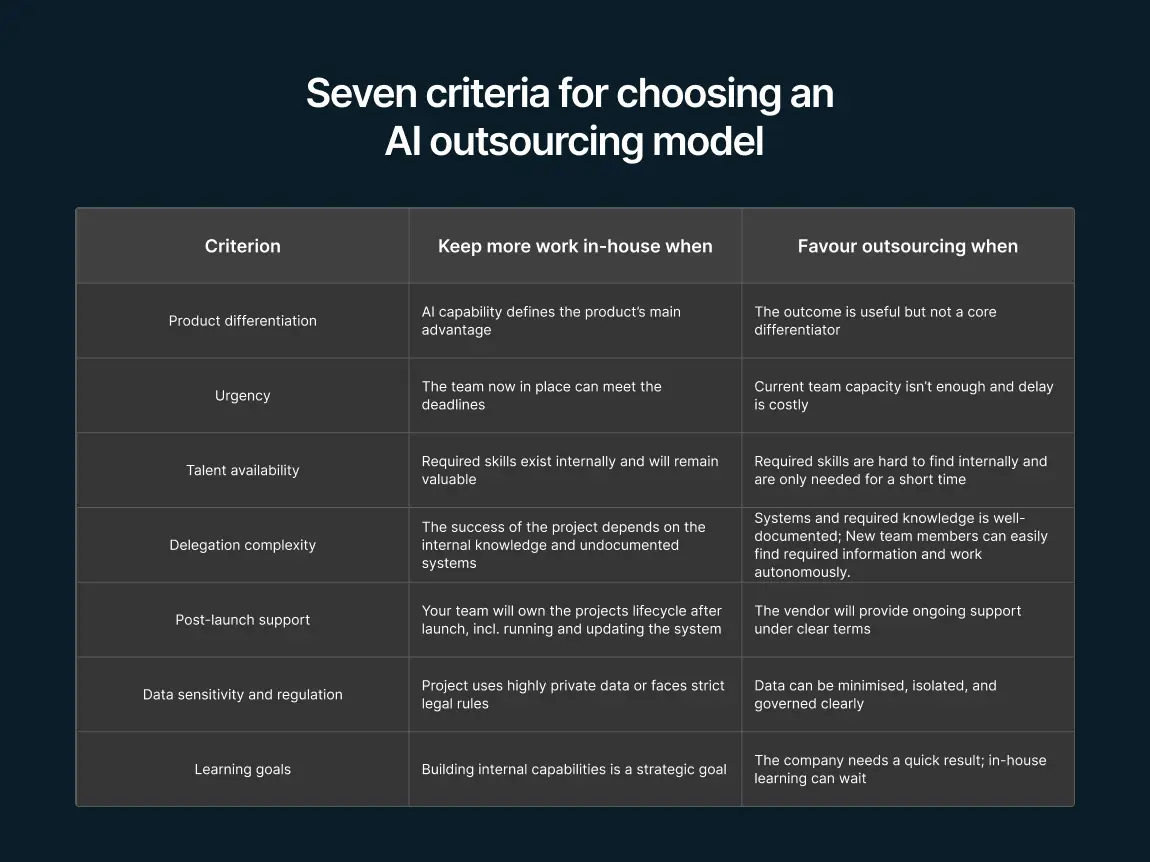 These factors can often pull in different directions. A key system that you want to build in-house may need the skills that the company cannot recruit quickly. This usually points toward a hybrid model, where the in-house team makes key choices and the outside team brings the talent needed for the build.
Turn the scores into a choice
An in-house build fits strategic work central to the company with highly sensitive data. The company needs enough technical and operational depth to build the system and run it later.
Full outsourcing fits projects with clear deliverables where a delay would hold back the launch. The agreement should set strong acceptance criteria.
A hybrid model fits many AI initiatives. The company owns the problem, data, and production decision. The external team adds build abilities and shares knowledge with the internal team. This keeps more learning inside the business. The wider trade-offs between in-house work and outsourcing can add useful points to this choice.
For example, let's take a bank testing an AI assistant for case review. An external team can be hired to build a PoC and run tests. Before that, the bank's data owner approves data and processing methods. Then, the law team defines guardrails and prohibited outputs. The internal product owner sets acceptance thresholds. After all the preparation work, the vendor builds and tests the PoC, but eventually it's the bank's team that decides if the system could go live.
This responsibility distribution allows the bank to move faster while keeping key business decisions inside (legal or product judgement).
Check readiness before you speak to outside AI teams
Even the best external teams need a strong foundation to start the project. Check these five areas before requesting a full build.
Confirm five starting points
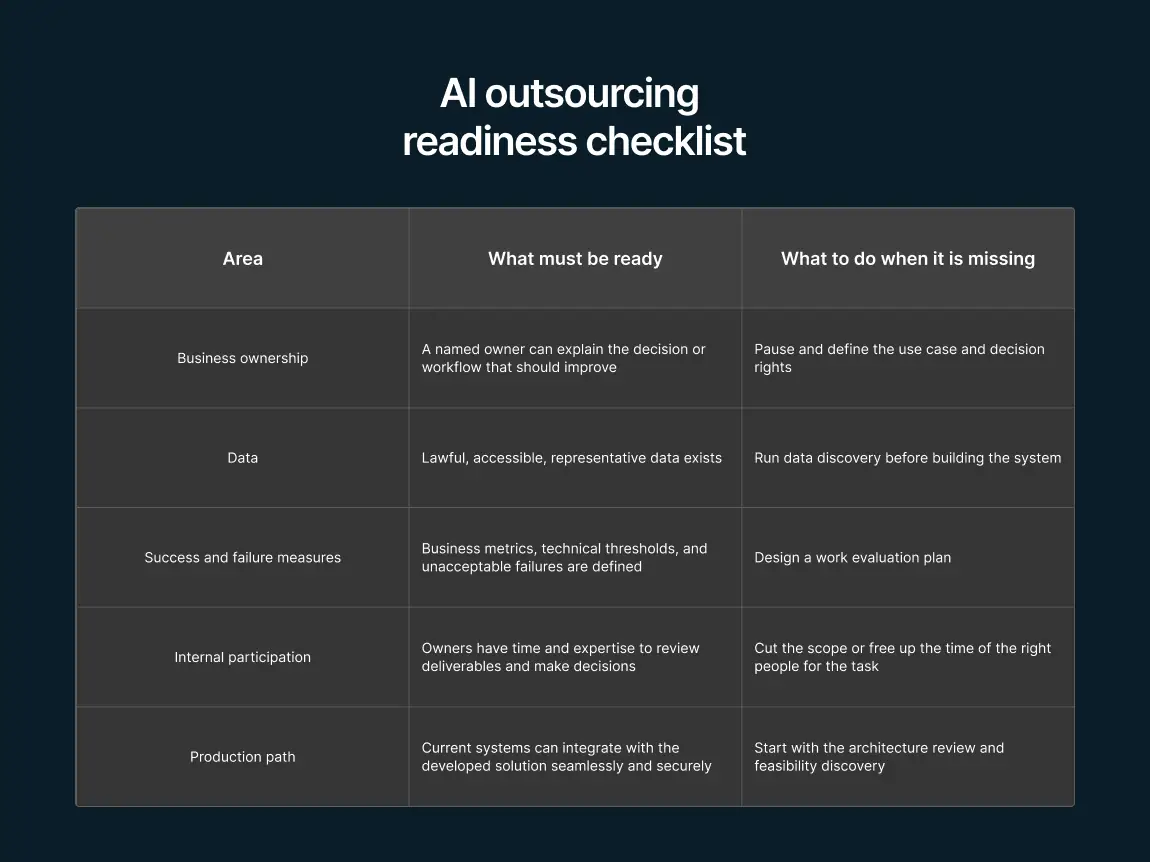 Deloitte found that 42% of the companies in its study felt highly ready in their AI plan. They felt less ready in areas such as data and people. The base for each system also got lower marks. The largest stop was a lack of worker abilities. A clear plan gives only part of the answer.
Use a smaller first step when one is missing
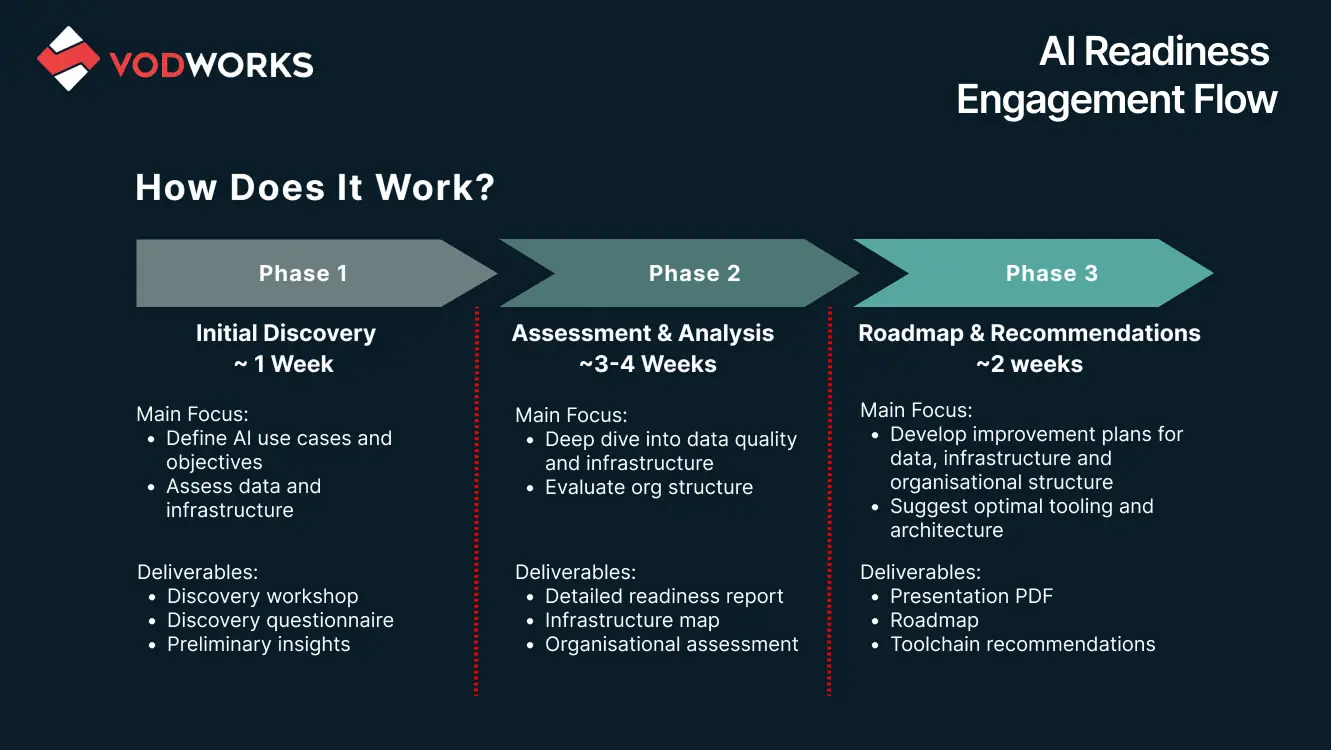
Narrow the partnership scope if one of the areas is lagging behind. Instead of contracting a team to build a full system, start with a data readiness assessment or a discovery engagement. A smaller engagement should closely study the point the riskiest point. For example, it could show whether the data you have can be used with the AI system you're planning.
Vodworks can help validate the use case and assess AI readiness before implementation begins. A focused initial engagement can evaluate data maturity, infrastructure, and security, ensuring the first investment is strategic and grounded in real business needs rather than building for the sake of it.
 ## Evaluate vendors by the actual proof they can show
A credible provider should demonstrate a proven track record of designing similar solutions and validating them in production to ensure they deliver real business value, rather than reproducing the ideal conditions of a prototype.
Ask for records from similar work
Request for anonymized examples of architecture decisions, evaluation plans, API flow diagrams, etc. Incident response SLAs and handover documentation can also help assess the vendor’s operational maturity. Sensitive details can be removed without hiding the structure or quality of the work.
Try to look beyond the polished marketing story in a vendor’s case studies. Ask what didn’t work, how the system changed after production deployment, and how the customer measured success.
Take red flags seriously
Guaranteed results without evaluation criteria should be alarming. Be careful when the portfolio includes claims without actual artifacts.
Unrestricted use of client data will probably trigger legal and security concerns, while shady subcontracting or no established handoff processes are signs that the vendor may not be a trustworthy partner.
Compare total project cost, not vendor rates with employee salaries
A fair cost check covers the full lifecycle of the system. Vendor fee and employee salaries are only two inputs.
Use one cost plan for every options
Use the same categories for in-house, outsourced, and hybrid scenarios.
Include:
- Discovery
- Data acquisition
- Preparation
- Engineering
- Integration
- Model services
- Infrastructure
- Evaluation
- Security
- Compliance
- Monitoring
- Support
Put each cost into one of three groups. Some costs are set from the start, some rise with use. Others are hard to know at first, for example data cleaning or the cost of each AI call.
Separate usage-based costs from fixed costs. Then, budget a rough estimate of every every high-uncertainty expense such as changing model prices (70% up since Q1'2026) and inference demands. Finally, model low, expected and high scenarios around the best view you have now. This view can show where a cheap build creates high running costs.
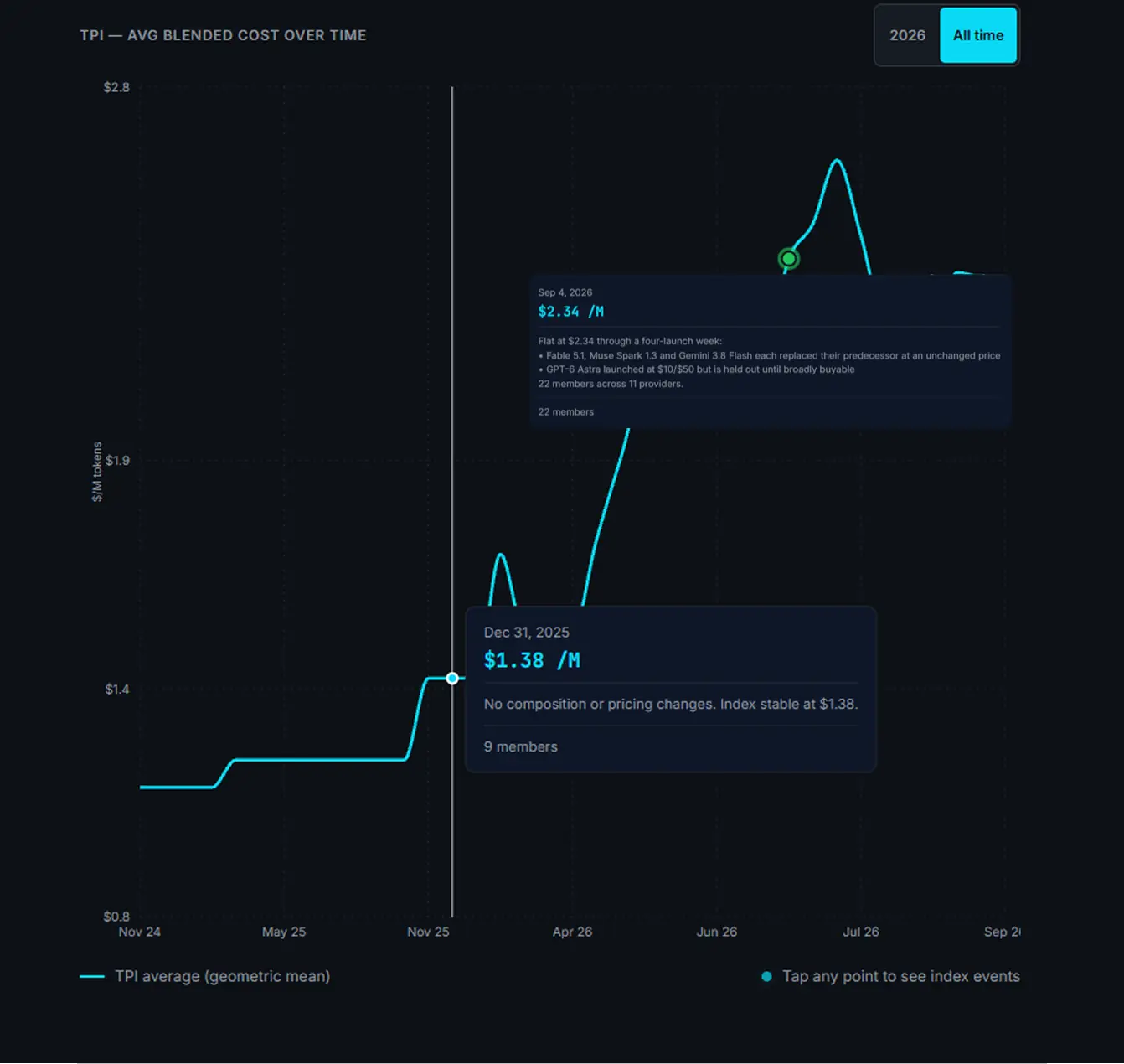 The chart showing changes in AI token cost in 2026.
In 2026, 98% of finance teams are actively managing AI costs, up from 31% two years earlier. By now, the cost of unaccounted AI usage is widely understood. For outsourced AI projects, long-term cost efficiency is determined during the early stages of development. Inefficient model usage doesn’t just increase costs at launch, it creates a growing cost burden over time as usage scales and model prices rise.
The same care should guide the build choice. This page on the full costs of outsourcing and in-house development covers further costs beyond salaries and project fees.
Choose the partnership model based on what's known
A fixed price model suits projects with stable scope and measurable acceptance. Time and materials model suits early discovery where much is unknown. A dedicated team fits an evolving roadmap with frequent changes.
Structure the partnership across individual milestones
Each milestone needs an approver from the client's side and an owner from the vendor. The contract should specify what happens after every failed milestone. Options may vary for some cases it needs more work or scope reduction and in severe cases it might end up with contract termination.
Set clear stage checks from early study to live use
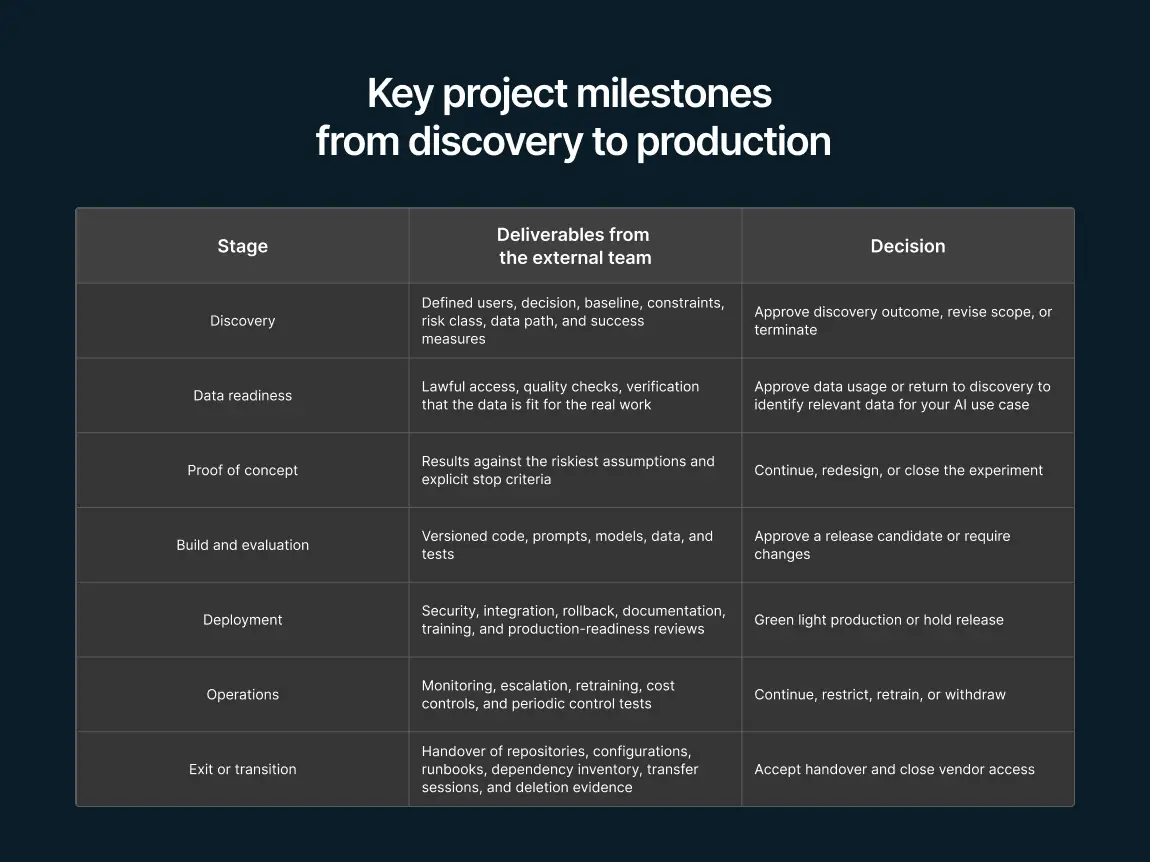 ### Put AI terms into the agreement and work plan
A strong outsourcing agreement makes ownership and permitted use clear across data, prompts, model weights, source code, outputs, and evaluation assets.
The same clarity should extend to the operating model. There should be defined decision rights around who can approve model changes, accept performance below an agreed threshold, or pause a production system. Regular review cadences during both development and operation will help technical and business stakeholders stay aligned.
Exit planning is another part of a healthy vendor relationship, not something to discuss only when the engagement is ending. Where practical, code and documentation can remain in client-controlled repositories, while knowledge transfer happens throughout the project rather than in the final week. Access removal, rollback procedures, and operational handover need to be established in advance, so they are already understood if they ever become necessary.
Final Thoughts
AI development outsourcing can add scarce expertise, speed, and flexible capacity. Its value depends on choosing a clear boundary and governing the complete system lifecycle. In-house delivery provides control, outsourcing provides focused external depth, and hybrid delivery can combine both.
Before comparing vendors, score the three sourcing options against the seven criteria. Then run the readiness gate and name the people who approve data, quality, risk, deployment, and post-launch operation. Those decisions reveal whether external delivery can create durable value without weakening internal accountability.

About the Author
Janna De Vos

With over a decade of experience in marketing, product, and strategy roles in the high-growth tech industry, Janna has a strong track record of team leadership, launching B2C and B2B products, and contributing to the growth of Southeast Asia's leading tech companies. Now, she leads Vodworks' marketing strategies, promoting its services and products, and is helping propel Vodworks towards its next phase of business.


Accelerate Your Projects With Our On-Demand Developers
Let's TalkTalent Shortage Holding You Back? Scale Fast With Us
Subscribe to our blog
Related Posts
Get in Touch with us
Thank You!
Thank you for contacting us, we will get back to you as soon as possible.
Our Next Steps
- Our team reaches out to you within one business day
- We begin with an initial conversation to understand your needs
- Our analysts and developers evaluate the scope and propose a path forward
- We initiate the project, working towards successful software delivery